How to Read Candlestick Chart: A Beginner-Friendly Guide to Price Action
Understanding how to read candlestick charts is one of the most important skills every trader must develop. Instead of seeing random red and green bars, you will start recognizing patterns, market psychology, and trading opportunities.
This guide simplifies the process so you can confidently analyze charts and make better trading decisions. For a deeper explanation, check the full guide here: https://h2tfunding.com/how-to-read-candlestick-chart/
1. What Is a Candlestick Chart?
A candlestick chart is a visual representation of price movements over a specific time period. Each candle shows four key data points: open, high, low, and close.
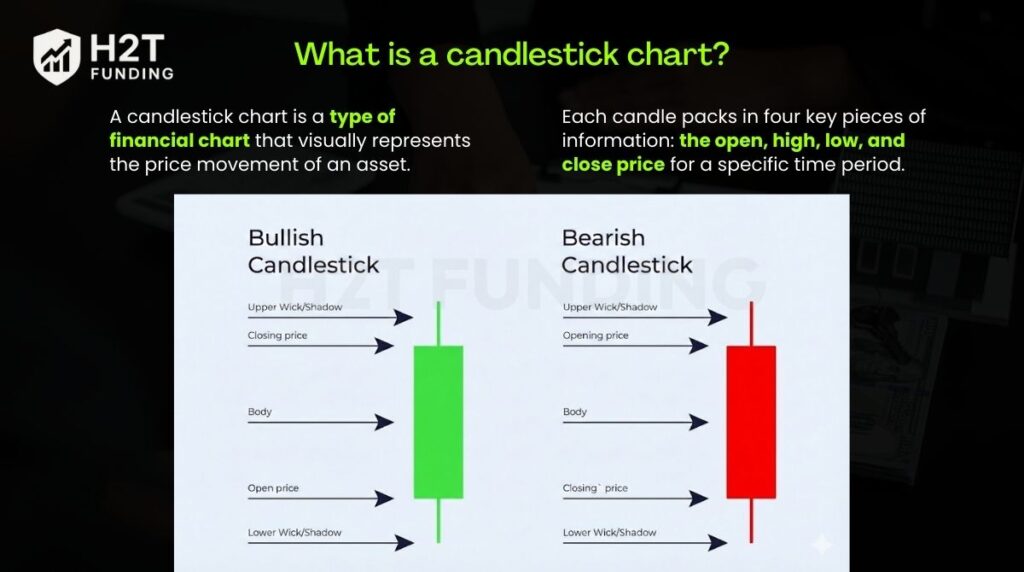 |
| A candlestick chart is a type of financial chart that visually represents the price movement of an asset |
This format helps traders quickly understand whether buyers or sellers are in control and how strong that control is.
2. Understanding Candlestick Structure
To master how to read candlestick chart, you need to understand its basic components.
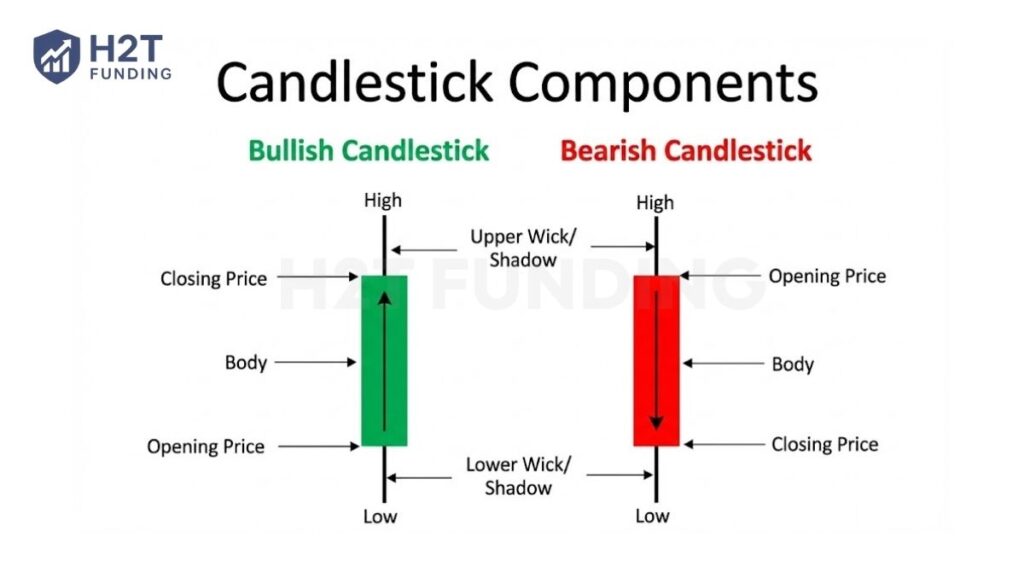 |
| The components of a candlestick |
2.1. The Body
The body represents the distance between the opening and closing price.
- Long body → strong momentum
- Short body → weak movement or indecision
2.2. The Wicks (Shadows)
Wicks show the highest and lowest prices reached.
- Long upper wick → rejection of higher prices
- Long lower wick → buying pressure
2.3. Candle Color
- Green candle → price closed higher (bullish)
- Red candle → price closed lower (bearish)
3. Step-by-Step Guide to Reading Candlestick Charts
3.1. Identify the Trend
Always start with the bigger picture. Look for:
- Uptrend → higher highs and higher lows
- Downtrend → lower highs and lower lows
- Sideways → consolidation
3.2. Choose the Right Timeframe
Higher timeframes (daily, weekly) are more reliable. Lower ones are faster but noisier.
3.3. Analyze Candle Bodies
Large candles indicate strong buying or selling pressure, while small ones suggest hesitation.
3.4. Study the Wicks
Wicks reveal rejection and hidden market behavior. They often signal reversals.
3.5. Look at Recent Price Action
Never rely on one candle. Always analyze multiple candles together to understand momentum.
3.6. Focus on Key Levels
Candlestick signals are strongest at support and resistance zones.
3.7. Confirm the Signal
Combine trend, pattern, and context before making any trading decision.
4. Key Candlestick Patterns to Know
4.1. Bullish Reversal Patterns
- Hammer
- Bullish Engulfing
- Morning Star
These patterns suggest a potential upward reversal after a decline.
4.2. Bearish Reversal Patterns
- Shooting Star
- Bearish Engulfing
- Evening Star
They indicate possible downward movement after an uptrend.
4.3. Indecision Patterns
- Doji
- Spinning Top
These show uncertainty and often appear before big moves.
5. How to Use Candlestick Charts Effectively
5.1. Combine with Support and Resistance
Patterns are more reliable when they form at key price levels.
5.2. Wait for Confirmation
Never trade immediately after spotting a pattern. Wait for the next candle to confirm direction.
5.3. Use Multiple Timeframes
Analyze higher timeframes for trend and lower ones for entry points.
6. Common Mistakes to Avoid
- Trading based on a single candle
- Ignoring the overall trend
- Overtrading every pattern
- Skipping risk management
- Expecting perfect accuracy
Avoiding these mistakes will significantly improve your consistency.
7. Conclusion
Learning how to read a candlestick chart is not about memorizing patterns but understanding market behavior. When you combine candlesticks with trend, key levels, and confirmation, you gain a powerful edge in trading.
Start simple, stay consistent, and build your skills over time. For a complete breakdown, visit: https://h2tfunding.com/how-to-read-candlestick-chart/
#funding
#h2tfunding
#nganpham
#finance
#howtoreadcandlestickchart
#nganphamh2t


Nhận xét
Đăng nhận xét