FTMO vs Apex: Which prop firm is better for traders?
Choosing the right proprietary trading firm can determine how quickly a trader progresses in the industry. Among the most discussed firms today are FTMO and Apex Trader Funding, two platforms that approach prop trading from very different angles.
While FTMO focuses on structured evaluations and CFD markets, Apex is designed primarily for futures traders who want speed and flexibility. Understanding how their rules, costs, and trading environments differ is essential before committing to an evaluation.
This guide explores the key differences between the two firms so traders can determine which funding model best fits their trading style. For a full breakdown of rules and features, read the detailed comparison here:
https://h2tfunding.com/ftmo-vs-apex/
1. Overview of FTMO and Apex trader funding
FTMO and Apex trader funding represent two different philosophies in the prop trading industry.
FTMO is widely known as one of the most established firms in the CFD and forex trading space. It provides traders access to instruments such as currencies, indices, commodities, stocks, and crypto through platforms like MetaTrader and cTrader. Its evaluation process emphasizes discipline and long-term consistency.
 |
| FTMO is widely recognized as the most established and trusted prop firm |
Apex trader funding, on the other hand, focuses almost entirely on the futures market. Instead of offering multiple evaluation phases, Apex provides a streamlined one-step evaluation designed to move traders toward funded status more quickly.
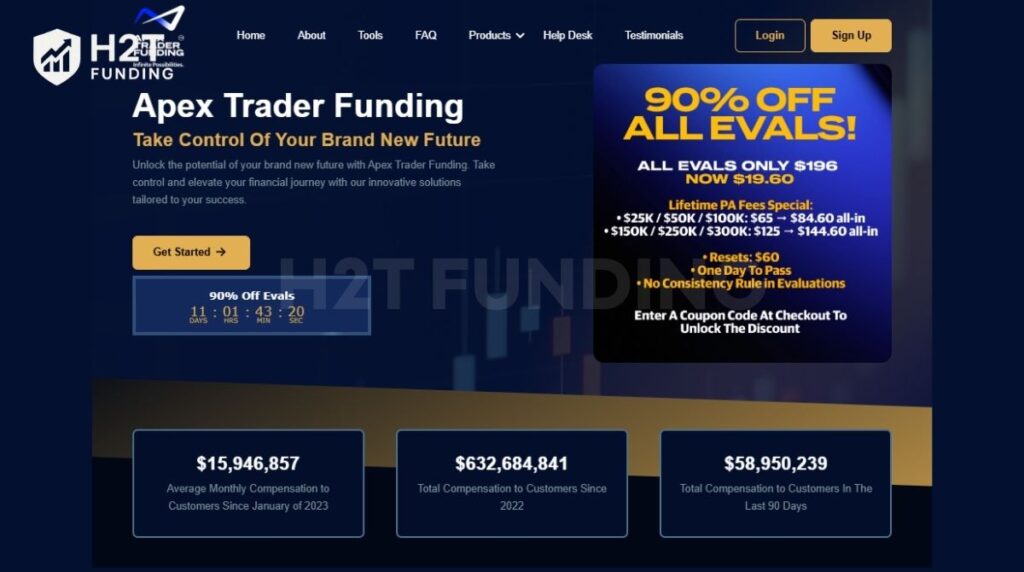 |
| Apex Trader Funding is the premier destination for dedicated Futures traders |
Both firms provide traders with access to significant capital, but their rules and trading environments differ significantly.
2. Evaluation process and funding model
One of the biggest differences between FTMO and Apex lies in how traders qualify for funded accounts.
FTMO uses a two-step evaluation model. Traders must first complete the FTMO Challenge, where they aim to achieve a 10% profit target while respecting strict drawdown rules. After passing this stage, traders move to the verification phase, which requires a smaller 5% profit target to confirm consistency.
Apex trader funding simplifies this process by offering a single evaluation phase. Traders only need to reach a profit target, usually around 6%, while respecting the account’s trailing drawdown rules.
Because Apex removes the second phase, many traders consider it a faster path to funding. However, the trailing drawdown system can make risk management more complex.
3. Trading rules and restrictions
Trading rules can significantly affect how strategies are executed.
FTMO implements clear risk management boundaries. Traders must respect a 5% daily loss limit and a 10% maximum loss limit based on the initial account balance. Additionally, trading around major economic news events is restricted for standard funded accounts.
Apex trader funding removes the daily loss limit entirely. Traders have greater flexibility to manage positions during volatile market conditions. News trading and weekend holding are allowed, which can benefit aggressive traders.
However, Apex imposes other restrictions, such as closing all trades before the end of the trading session and complying with consistency rules related to payout eligibility.
These contrasting rule sets highlight the difference between FTMO’s structured environment and Apex’s flexible but technically demanding system.
4. Markets and trading platforms
The markets available to traders also play a crucial role when choosing between FTMO and Apex.
FTMO primarily supports forex and CFD markets. Traders can access currencies, indices, metals, commodities, and cryptocurrencies through well-known retail platforms like MT4, MT5, and cTrader. These platforms are widely used and familiar to many traders.
Apex trader funding focuses exclusively on futures contracts traded on major exchanges such as the CME. To support this environment, Apex offers specialized futures platforms like NinjaTrader, Tradovate, and Rithmic.
For traders who specialize in forex or multi-asset CFD strategies, FTMO offers more variety. Futures traders, however, may prefer Apex’s direct market access and professional trading tools.
5. Profit split and scaling opportunities
Profit sharing and account growth are key considerations for prop firm traders.
FTMO typically begins with an 80% profit split, which can increase to 90% as traders demonstrate consistent profitability. The firm also offers a scaling plan that gradually increases account size over time, potentially reaching several million dollars in managed capital.
Apex trader funding introduces a unique incentive. Traders can keep 100% of the first $25,000 in profits, after which the standard profit split moves to 90%. This structure makes Apex particularly attractive for skilled futures traders capable of generating profits quickly.
However, Apex’s scaling system focuses more on unlocking full contract size rather than increasing the overall account balance.
6. Evaluation fees and pricing structure
Cost structure is another important factor when comparing prop firms.
FTMO charges a one-time evaluation fee that varies depending on account size. One major advantage of this model is that the fee is refunded after the trader receives their first profit payout.
Apex trader funding operates on a monthly subscription model. Traders pay a recurring fee for their evaluation account until they pass the challenge or cancel the subscription.
The FTMO model rewards traders who can pass quickly, while Apex’s subscription structure provides flexibility for traders who may need more time to reach their profit target.
7. Which firm is easier to pass?
The answer depends on how traders manage risk and time.
Apex trader funding may appear easier because the profit target is lower and the evaluation only requires one phase. However, the trailing drawdown mechanism can make account management more difficult during volatile market conditions.
FTMO’s evaluation requires more total profit across two stages, but its fixed drawdown limits make risk management easier to track.
Traders who prefer predictable risk levels often find FTMO easier to manage, while experienced futures traders may find Apex’s single-step process more appealing.
8. Which prop firm should traders choose?
The choice between FTMO and Apex depends largely on trading style and market preference.
FTMO is often the better option for traders who focus on forex and CFDs, value structured risk management, and prefer stable trading rules. Its long-standing reputation and professional ecosystem make it a strong choice for traders seeking consistency.
Apex trader funding is designed for futures specialists who want faster access to funded accounts and fewer restrictions on trading strategies.
Both firms offer legitimate opportunities, but the right choice ultimately depends on the trader’s experience level and preferred market environment.
#funding
#h2tfunding
#nganpham
#finance
#ftmovsapex
#nganphamh2t


Nhận xét
Đăng nhận xét