The Funded Trader vs FundedNext: Which prop firm gives traders the real advantage?
Choosing between The Funded Trader vs FundedNext is not just about profit split percentages. It is about payout speed, evaluation difficulty, risk structure, and long-term scaling potential.
One firm promotes a structured, gamified career path with multiple challenge models. The other focuses on execution speed, flexible rules, and fast withdrawals. So which one truly gives traders the edge in 2026?
Let’s break it down.
1. Core philosophy and trading experience
The Funded Trader (TFT) is built around a structure. Its ecosystem feels like a competitive trading kingdom, where traders climb through challenge tiers such as Standard, Royal, Knight, and Dragon.
FundedNext positions itself as a performance accelerator. It reduces friction in the evaluation process and prioritises faster payouts, including 24-hour withdrawal processing on certain plans.
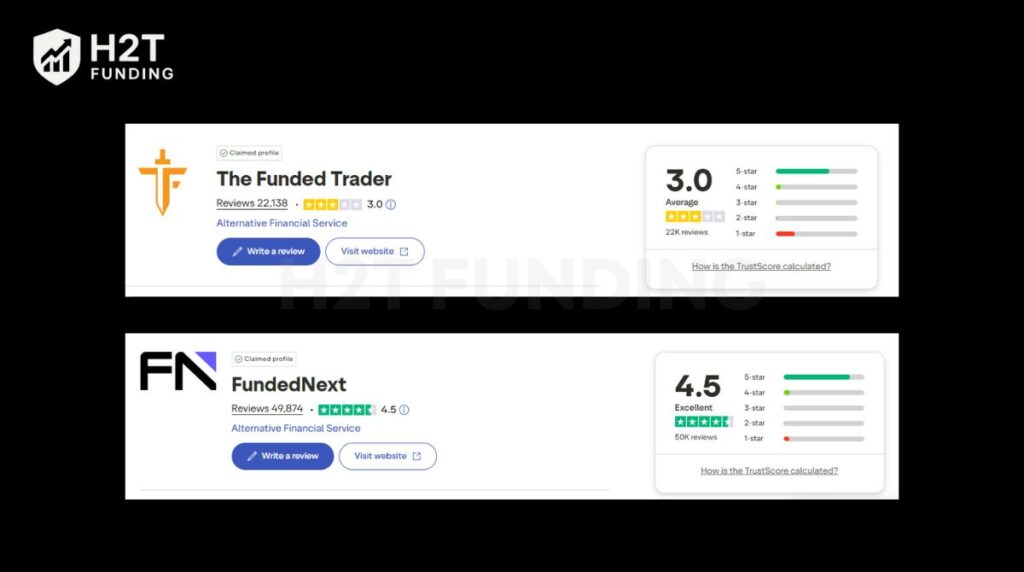 |
| The Funded Trader vs FundedNext comparison |
In short:
The Funded Trader = structured progression.
FundedNext = speed and flexibility.
Your preferred environment matters more than marketing claims.
2. Evaluation models and challenge flexibility
The Funded Trader offers:
1-step, 2-step, and 3-step (Dragon) models
Minimum trading days on certain plans
Equity-based and trailing drawdown options
FundedNext offers:
1-step and 2-step challenges
Instant funding (Express model)
No time limit on several programs
FundedNext’s no time pressure structure reduces stress for swing traders and patient strategies. TFT, on the other hand, emphasises discipline through structured progression.
If you prefer flexibility, FundedNext has the edge. If you value gamified progression, TFT may appeal more.
3. Drawdown structure and risk management
Drawdown calculation directly affects the survival rate.
The Funded Trader:
10% maximum drawdown (Standard/Royal)
6% on Knight challenge
Often equity-based calculation
FundedNext:
10% maximum drawdown (Stellar/Evaluation)
6% on Express
Balance-based drawdown available
Balance-based drawdown is generally easier to manage for swing traders because floating profits do not reduce your risk cushion.
From a pure risk management perspective, FundedNext offers slightly more forgiving conditions.
4. Payout speed and liquidity
Liquidity builds confidence.
The Funded Trader:
Weekly or biweekly payouts
Structured payout cycle
FundedNext:
Biweekly payouts
24-hour processing option
Instant funding models
For traders who prioritise quick access to profits, FundedNext clearly wins in payout speed.
Fast withdrawals reduce psychological pressure and increase trust.
5. Profit split and scaling potential
The Funded Trader:
80% starting split
Up to 95% for VIP traders
Scaling up to approximately $1.2M challenge balance
FundedNext:
80% starting split
Up to 90–100% depending on performance and promotions
Scaling up to $4,000,000
FundedNext’s aggressive scaling structure makes it appealing for high-performing traders looking to grow quickly.
TFT offers a more traditional, career-style scaling ladder.
6. Platforms and tradable markets
The Funded Trader supports:
MT4
MT5
FundedNext supports:
MT4
MT5
cTrader
MatchTrader
FundedNext also provides access to futures trading and a broader CFD range, offering more diversification opportunities.
If platform choice and asset diversity matter to you, FundedNext offers more versatility.
7. Trust, reputation, and community sentiment
Trust plays a major role in prop firm selection.
FundedNext currently maintains strong positive sentiment, particularly regarding payout speed and customer support responsiveness.
The Funded Trader remains a well-known brand with a massive community. However, recent operational transitions and platform changes have created mixed feedback from traders.
When choosing a prop firm, consistency and transparency should be major decision factors.
8. Which firm is easier to pass?
Both firms removed strict time limits on several programs, which improves pass probability.
However:
FundedNext’s balance-based drawdown gives swing traders more breathing room.
TFT’s equity-based and trailing drawdown (on some plans) requires tighter control.
For most traders, FundedNext may offer a slightly easier path due to simpler risk calculations.
That said, traders who need higher leverage (such as 1:200 on Royal) may prefer TFT.
9. Who should choose which firm?
Choose The Funded Trader if you:
Prefer structured career progression
Want access to higher leverage options
Thrive in competitive community environments
Value traditional scaling paths
Choose FundedNext if you:
Prioritise fast payouts
Want flexible drawdown rules
Need access to multiple trading platforms
Aim for aggressive scaling
Your trading personality should guide your decision.
10. Final verdict: structure or speed?
The The Funded Trader vs FundedNext debate is not about which firm is universally better.
It is about alignment.
The Funded Trader suits disciplined traders who value structure and long-term progression.
FundedNext suits performance-driven traders who want faster liquidity, flexible risk rules, and aggressive scaling.
To explore the full breakdown, visit:
https://h2tfunding.com/the-funded-trader-vs-fundednext/
#funding
#h2tfunding
#nganpham
#finance
#thefundedtradervsfundednext
#nganphamh2t


Nhận xét
Đăng nhận xét