The E8 funding vs FTMO: which prop firm truly fits your trading style in 2026?
Choosing the right proprietary trading firm can dramatically impact your long-term success. The E8 Funding vs FTMO debate continues to dominate discussions among traders in 2026 because both firms offer strong but very different pathways to funding.
One represents structure, discipline, and long-term credibility. The other promotes flexibility, faster access to capital, and modern scaling. Understanding these differences is critical before you commit your time and challenge fee.

1. Reputation and industry position
When evaluating prop firms, credibility matters.
FTMO has built a global reputation over years of consistent payouts, transparent rules, and structured evaluation standards. Many traders consider passing FTMO a professional milestone because of its strict 10% first-phase target and fixed risk parameters.
E8 Funding, while newer, has rapidly gained attention for its flexible evaluation models and modern trading infrastructure. It appeals to traders who want more control over how they approach funding.
If you prioritize proven stability and brand trust, FTMO holds the edge. If you value innovation and adaptable models, E8 Funding offers a fresh alternative.
2. Evaluation models and profit targets
The evaluation structure directly affects your probability of success.
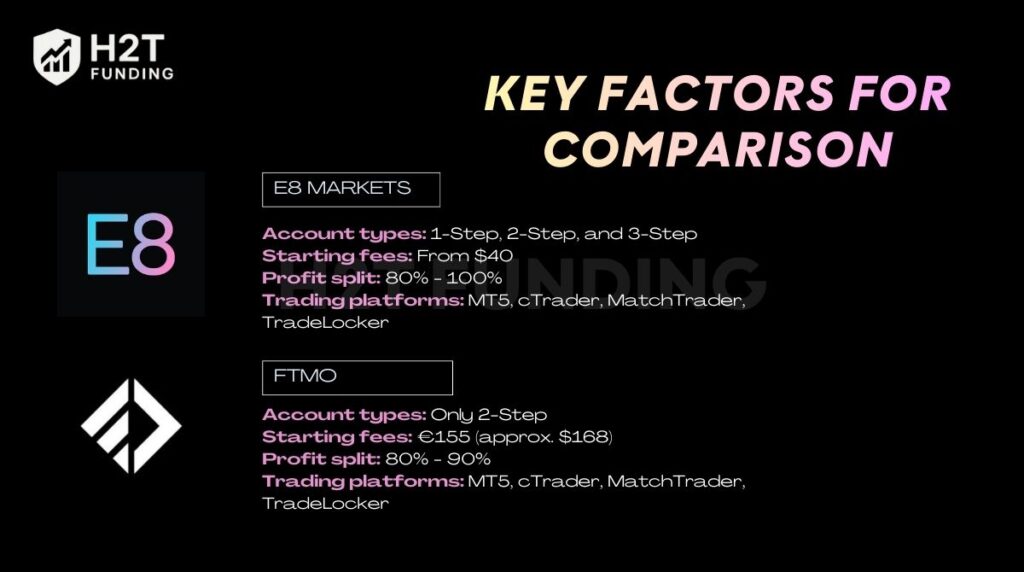 |
| Key factors for comparison: E8 Funding vs FTMO |
2.1. E8 Funding evaluation flexibility
E8 Funding provides multiple models:
1-step evaluation
2-step evaluation
3-step evaluation
Profit targets range between 4% and 8%, depending on the model selected. There are no minimum trading days, allowing experienced traders to pass quickly.
This flexibility suits confident traders who want faster access to funded status.
2.2. FTMO standardized process
FTMO uses a single 2-step evaluation:
Phase 1: 10% profit target
Phase 2: 5% profit target
Minimum 4 trading days required
The structure is rigid but clear. It rewards discipline and consistency over aggressive risk-taking.
3. Risk management and drawdown rules
Risk control is where many traders fail.
3.1. FTMO drawdown structure
FTMO applies:
5% daily loss limit
10% maximum loss limit
These rules are fixed and based on the starting daily balance. The clarity simplifies risk planning but leaves no room for customization.
3.2. E8 Funding customizable drawdown
E8 Funding allows drawdown customization depending on the chosen account.
Daily limits and overall drawdowns can vary, offering more breathing room for certain strategies. However, traders must fully understand how equity-based calculations work to avoid violations.
Flexibility brings opportunity, but also responsibility.
4. Profit split and scaling potential
Once funded, growth matters.
4.1. Profit split comparison
FTMO starts at 80%, scaling up to 90%.
E8 Funding offers 80% to 100% on select plans.
The higher potential split at E8 is attractive, but FTMO’s structured system provides predictable progression.
4.2. Scaling philosophy
FTMO increases capital by 25% every four months if performance targets are met.
E8 Funding uses payout-based scaling, allowing account balance growth after each successful withdrawal. This creates faster compounding potential for consistent traders.
5. Trading conditions and costs
Trading costs significantly impact net profitability.
FTMO offers:
Higher leverage (up to 1:100 on forex)
Zero commission on indices
Competitive crypto percentage fees
E8 Funding provides:
Lower leverage limits
Futures market access
Competitive forex commissions
Traders who rely heavily on index trading may benefit more from FTMO’s cost structure. Futures traders will find E8 Funding more appealing.
6. Platform access and instrument variety
Both firms support major platforms such as MT5 and cTrader.
Key differences include:
FTMO provides stock CFDs.
E8 Funding provides futures trading.
U.S. traders face platform restrictions at both firms, but each offers designated solutions to maintain accessibility.
Your preferred asset class should heavily influence your choice.
7. Payout reliability and withdrawal flexibility
Both firms refund challenge fees upon successful funding.
FTMO operates with a structured 14-day payout cycle and low withdrawal minimums.
E8 Funding offers on-demand payout options depending on account type, though certain consistency rules must be met.
For traders seeking faster liquidity access, E8 Funding may provide greater flexibility.
8. Educational support and trader development
FTMO excels in structured education through its Academy and advanced analytics tools like Account MetriX. It provides a highly professional development ecosystem.
E8 Funding focuses more on community engagement, particularly through its active Discord channel, offering peer interaction and practical discussion.
If you want formal education and analytics, FTMO leads. If you prefer community-driven support, E8 may feel more engaging.
9. Final verdict: which firm should you choose?
The E8 Funding vs FTMO decision depends entirely on your priorities.
Choose FTMO if:
You value industry reputation
You prefer fixed, predictable rules
You want higher leverage
You trade indices or stock CFDs
Choose E8 Funding if:
You want flexible evaluation models
You prefer faster scaling
You trade futures
You seek lower entry costs
Both firms are legitimate and competitive in 2026. The best choice aligns with your strategy, psychology, and long-term trading goals.
For the full in-depth breakdown, visit:
https://h2tfunding.com/e8-funding-vs-ftmo/
#funding
#h2tfunding
#nganpham
#finance
#thee8fundingvsftmo
#nganphamh2t


Nhận xét
Đăng nhận xét