Quantitative trading firms: Who dominates algorithmic finance in 2026?
Quantitative trading firms are redefining how global markets operate. Instead of relying on intuition or discretionary decisions, these firms use data science, algorithms, and automation to trade across equities, futures, crypto, and derivatives at extreme speed.
In 2026, competition among quantitative trading firms is more intense than ever. From high-frequency trading desks to AI-powered hedge funds, the industry continues to evolve rapidly.
1. What are quantitative trading firms?
Quantitative trading firms are financial institutions that use mathematical models and computer algorithms to identify and execute trading opportunities.
 |
| Quant trading firms use algorithms and automated systems to spot trading chances |
Rather than manually placing trades, these firms:
Collect massive datasets
Build predictive statistical models
Backtest strategies
Deploy automated execution systems
Monitor risk in real time
Their edge comes from speed, precision, and discipline. Decisions are driven by data, not emotion.
2. Core types of quantitative trading firms
Not all quant firms operate the same way. They typically fall into several key categories.
2.1. High-frequency trading firms
HFT firms execute trades in microseconds. They profit from tiny price inefficiencies and depend heavily on low-latency infrastructure.
Their advantages include:
Co-located servers
Custom hardware
Real-time order routing
Market microstructure modeling
Although margins per trade are small, high volume creates substantial cumulative returns.
2.2. Proprietary trading firms
Prop firms trade their own capital. They can adopt flexible strategies such as arbitrage, volatility trading, and short-term market making.
They reward traders based on performance and often combine automation with human oversight.
2.3. Systematic hedge funds
Systematic hedge funds manage large diversified portfolios using quantitative models. They often operate under multi-manager “pod” structures.
Their focus is on:
Risk-adjusted returns
Alpha generation
Portfolio optimization
Machine learning integration
2.4. Crypto-native quant firms
Digital asset firms apply traditional quantitative techniques to 24/7 blockchain markets. They specialize in:
Cross-exchange arbitrage
Market making
Volatility modeling
Liquidity provision
The crypto space has become one of the fastest-growing segments of quantitative finance.
3. How quantitative trading firms generate profit
Quantitative trading firms monetize inefficiencies in several ways.
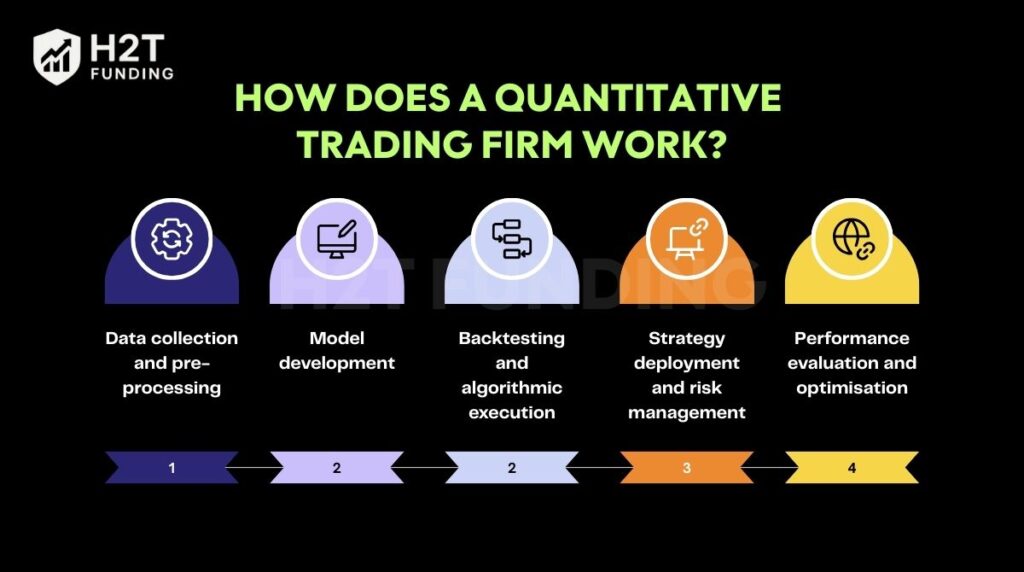 |
| How does a quantitative trading firm work |
3.1. Statistical arbitrage
Models detect mispricing between correlated assets. Positions are opened simultaneously to capture mean reversion.
3.2. Market making
Firms continuously quote buy and sell prices, profiting from bid-ask spreads while managing inventory risk.
3.3. Momentum and trend following
Algorithms detect sustained price movements and position accordingly.
3.4. Machine learning prediction
AI-driven models identify nonlinear patterns within large datasets to forecast short-term returns.
Execution speed and disciplined risk control remain critical to all approaches.
4. Technology and infrastructure advantage
In 2026, infrastructure determines competitiveness.
Leading quantitative trading firms invest heavily in:
High-performance computing clusters
Custom execution engines
Data warehousing and alternative datasets
AI and deep learning research
Redundant risk control systems
Latency reduction, execution precision, and system stability separate elite firms from average competitors.
5. How quant firms evaluate trader performance
Top firms assess traders beyond raw profitability.
They measure:
Sharpe ratio and risk-adjusted return
Maximum drawdown control
Alpha generation vs benchmarks
Execution efficiency
Model robustness and adaptability
Consistency and disciplined process matter more than one-time gains.
6. Key risks facing quantitative trading firms in 2026
Despite their sophistication, quant firms face major challenges.
6.1. Model overfitting
A strategy may perform well historically but fail in live conditions.
6.2. Market regime shifts
Sudden volatility or structural changes can invalidate historical assumptions.
6.3. Infrastructure failures
System outages or latency spikes can cause cascading losses.
6.4. Regulatory oversight
Increasing scrutiny on algorithmic trading requires transparency and compliance investment.
The firms that survive are those that balance innovation with resilience.
7. Why quantitative trading firms matter
Quantitative trading firms are essential to modern financial markets because they:
Provide liquidity
Narrow bid-ask spreads
Improve price efficiency
Reduce emotional volatility
Drive technological innovation
They form the invisible backbone of today’s financial ecosystem.
8. Future outlook for quantitative trading firms
Looking ahead, the industry will likely move toward:
Greater AI integration
Adaptive reinforcement learning models
Cross-asset predictive systems
Hybrid human-machine collaboration
Increased crypto and tokenized asset exposure
Quantitative trading firms will continue to shape the structure and efficiency of global markets.
9. Final thoughts
The rise of quantitative trading firms marks a permanent shift in finance. Data, automation, and disciplined risk management now define competitive advantage.
Whether in equities, futures, or crypto, the firms leading in 2026 are those that master speed, precision, and adaptability.
For a complete breakdown of the top 100+ firms, visit:
https://h2tfunding.com/quantitative-trading-firms/
#funding
#h2tfunding
#nganpham
#finance
#quantitativetradingfirms
#nganphamh2t


Nhận xét
Đăng nhận xét