Why only a small percent of day traders make money: A realistic breakdown
The question “What percent of day traders make money?” is one of the most important, yet misunderstood topics for aspiring traders. While day trading holds the promise of freedom and fast profits, the statistical reality is far more sobering. This guide breaks down why such a small group succeeds, what separates them from the majority, and what you must understand before stepping into the fast-moving world of intraday trading.
1. Understanding how day trading really works
Day trading is not passive investing; it is a high-pressure environment where traders must make rapid, accurate decisions based on market movements. Prices shift within seconds, and every entry or exit has consequences. Without a clear structure, traders fall into emotional decision-making, one of the main reasons success rates remain extremely low.
The speed of this profession means that skill, discipline, and emotional control matter just as much as technical strategy.
 |
| What is day trading? |
2. What the statistics show about day trader success
Although different markets produce different numbers, most studies point to the same conclusion: only a very small minority of day traders make money consistently.
Research across Brazil, Taiwan, and the U.S. suggests:
Most day traders lose money within their first year.
Between 1% and 20% become consistently profitable, depending on the market.
Less than 1% outperform the market long term after fees.
These numbers are not meant to discourage, but to bring clarity: day trading is a competitive skill, not a shortcut to fast wealth.
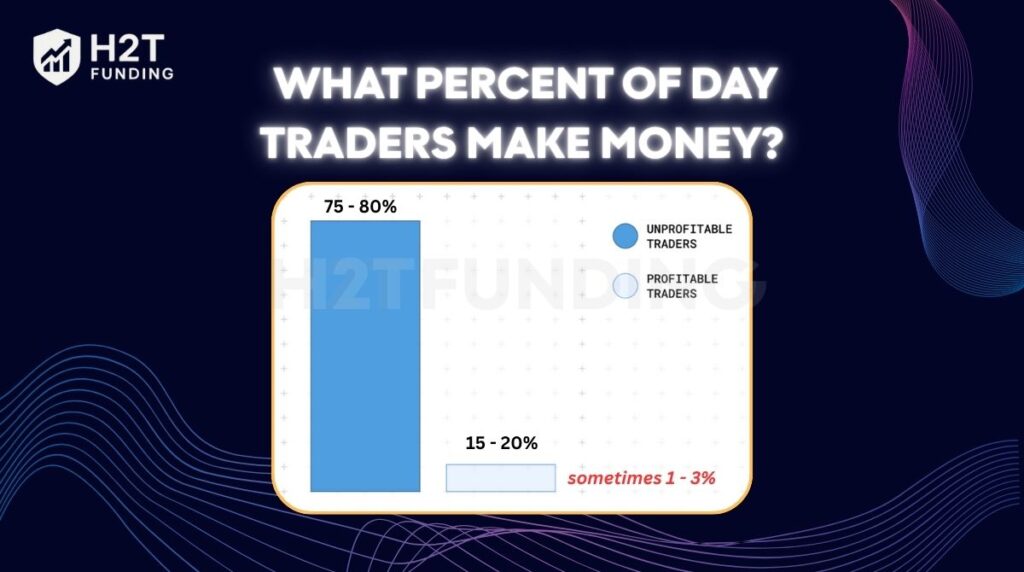 |
| What percent of day traders make money |
3. Why so few traders achieve profitability
Several recurring behaviors consistently appear among unsuccessful traders:
Overtrading due to impatience or the urge to always be in the market
Poor risk management, especially oversizing positions
Trading without a proven strategy or relying on intuition
Emotional reactions, such as revenge trading or FOMO
Underestimating slippage, spread costs, and fees
When combined, these factors create a negative expectancy, meaning that even with occasional wins, the account trends downward over time.
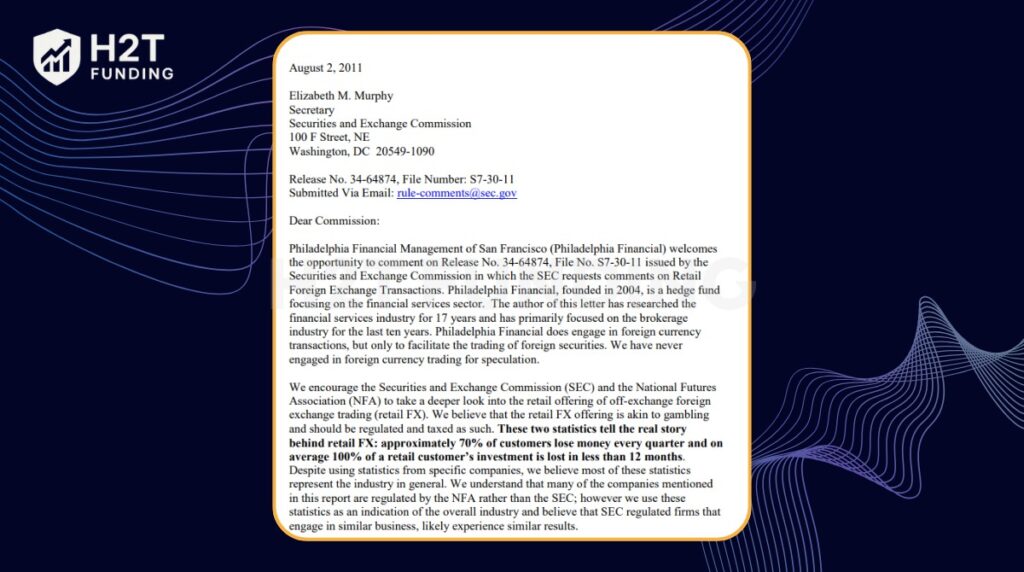 |
| Report from the U.S. Securities and Exchange Commission |
4. What successful traders do differently
The small percentage who succeed share common traits:
They follow a strict, tested trading strategy
They understand risk deeply and never oversize trades
They think in probabilities, not predictions
They maintain trading journals to refine performance
They treat trading as a business, not a gamble
Consistency, discipline, and continuous education define long-term profitability — not luck or instinct.
5. Improving your chances in a statistically difficult field
While you cannot change the statistics, you can change your preparation:
Start with demo trading to understand your strategy
Use a journal to track behavioral patterns
Focus on one or two setups rather than many
Practice risk control relentlessly
Join communities or mentorship programs for structure
For traders seeking more capital and a professional environment, prop firms like H2T Funding offer an alternative path to operate with larger accounts while minimizing personal risk.
6. Conclusion
The harsh truth is that the percentage of day traders who make money long term is very small — but that does not mean success is impossible. Those who commit to proper education, risk management, emotional control, and disciplined execution place themselves in the best possible position to join the profitable minority.
Read the full breakdown here: https://h2tfunding.com/what-percent-of-day-traders-make-money/
#funding
#h2tfunding
#nganpham
#finance
#whatpercentofdaytradersmakemoney
#nganphamh2t


Nhận xét
Đăng nhận xét