What is the price to earnings ratio and how to use it for smarter investing
1. Why the price to earnings ratio is so widely used
The price to earnings ratio helps investors understand how the market values a company’s earnings. It translates complex financial data into a single number, making it easier to compare stocks across the same industry or market segment.
 |
| The P/E ratio shows how much investors are willing to pay for each dollar of a company’s earnings |
2. What the P/E ratio reveals about market expectations
A stock’s P/E ratio reflects expectations about future growth. Higher ratios usually suggest optimism about earnings expansion, while lower ratios may indicate slower growth or perceived risk. The ratio represents sentiment as much as fundamentals.
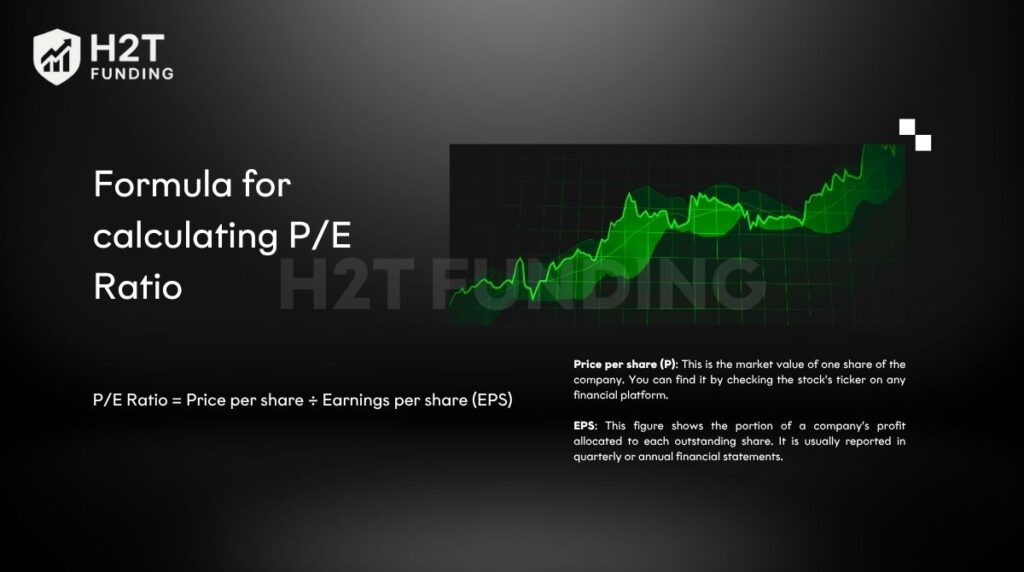 |
| Formula for calculating P/E Ratio |
3. Comparing P/E ratios across industries
Not all P/E ratios should be judged equally. Technology companies often trade at higher multiples due to growth potential, while utilities and financial firms usually have lower averages. Comparing a stock’s P/E to its industry peers provides more accurate insights.
4. Using P/E alongside growth metrics
The price to earnings ratio becomes more powerful when paired with growth indicators. Metrics like the PEG ratio help investors evaluate whether a high P/E is justified by future earnings growth. Without this comparison, valuation conclusions may be misleading.
5. Limitations every investor should understand
The P/E ratio ignores debt, cash flow quality, and balance sheet strength. It also becomes irrelevant for companies with negative earnings. Relying on P/E alone can lead to poor decisions, especially during speculative market cycles.
6. How long-term investors use the P/E ratio
Long-term investors often compare current P/E levels with historical averages to spot potential mispricing. A stock trading below its long-term average may offer an opportunity if fundamentals remain strong.
7. Common mistakes when using the P/E ratio
Many investors assume a low P/E always means cheap or a high P/E always means expensive. In reality, valuation depends on growth prospects, industry dynamics, and overall market conditions. Context is critical.
8. Practical tips for applying the P/E ratio
Investors should use P/E as a screening tool, not a final decision-maker. Combining it with return on equity, revenue growth, and cash flow analysis provides a clearer picture of a company’s true value.
9. Final thoughts on valuation discipline
Understanding what is the price to earnings ratio helps investors think more logically about stock prices. When used correctly and in combination with other metrics, it supports smarter, more disciplined investment decisions.
Learn more here:
👉 https://h2tfunding.com/what-is-the-price-to-earnings-ratio/
#funding
#h2tfunding
#nganpham
#finance
#whatisthepricetoearningsratio
#nganphamh2t


Nhận xét
Đăng nhận xét