Understanding the Topstep daily loss limit in 2025
The Topstep daily loss limit is one of the most important guardrails for futures traders. It prevents oversized intraday drawdowns, encourages discipline, and shapes how traders manage risk in both Combines and funded accounts. This guide breaks down how the limit works today, especially after the introduction of TopstepX, and how traders can use it to improve consistency.
1. What the daily loss limit actually means
The daily loss limit is a fixed amount you cannot exceed in a single trading session. Topstep measures this by your net P&L, including realized trades, unrealized P&L, fees, and commissions. Once your equity hits the limit, the system automatically liquidates open trades and pauses activity until the next session.
This rule prevents impulsive behavior and teaches traders to recognize when a session is no longer favorable.
2. Why does it reset every trading day
Topstep defines its trading day as 5:00 PM CT to 3:10 PM CT the next calendar day. When this session ends, your daily limit resets, allowing you to start fresh without carrying yesterday’s drawdown forward.
This feature differentiates the daily limit from the trailing drawdown, which moves only with realized profits and never resets downward.
3. Current daily loss limits by account size
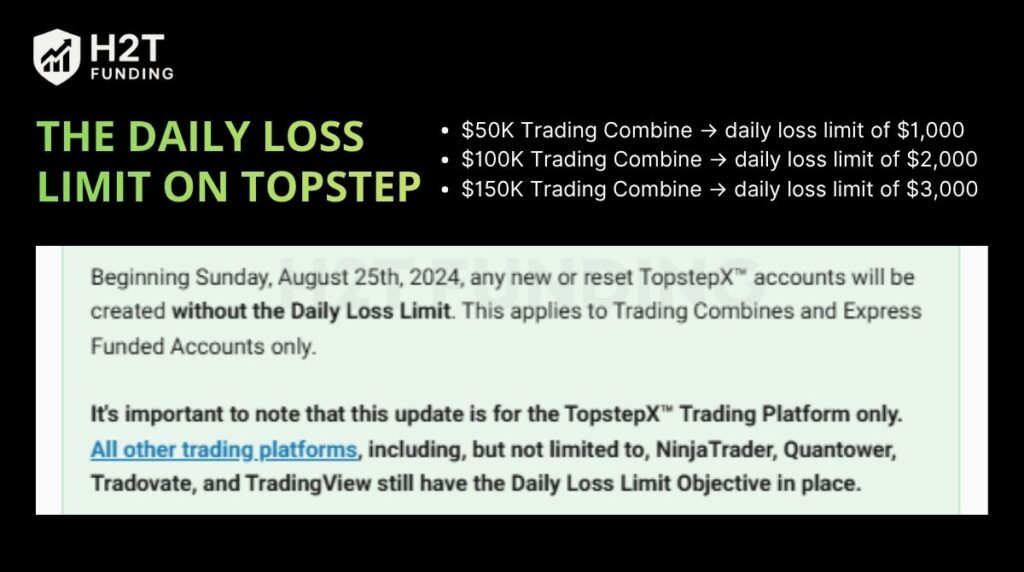
Topstep assigns predefined levels depending on the Combine size:
-
$50K account: $1,000
-
$100K account: $2,000
-
$150K account: $3,000
These caps act as an intraday circuit breaker designed to protect traders before long-term damage occurs.
4. How TopstepX changed the rule
As of August 2024, new or reset TopstepX Combines and Express Funded Accounts no longer include a firm-wide daily loss limit.
This means traders must create and manage their own risk levels manually, an improvement for disciplined traders but a challenge for those who rely on automatic safeguards.
All other platforms (TradingView, NinjaTrader, Quantower, Tradovate) still enforce the traditional limits.
5. How to manage the limit without breaking it
The key to staying within the daily loss limit is maintaining awareness of net P&L, not just closed trades. Useful techniques include:
-
Using stop-loss orders on every position
-
Keeping position sizes small enough to absorb volatility
-
Setting a personal daily limit below the official threshold
-
Monitoring account equity instead of account balance
-
Walking away once your planned daily risk is reached
These habits prevent forced liquidations and ensure steady progress through the evaluation or funding stages.
6. Daily loss limit vs. trailing drawdown
Traders often confuse these two risk rules, but they serve different purposes:
| Feature | Daily loss limit | Trailing drawdown |
|---|---|---|
| Timeframe | One trading day | Entire evaluation or funded account |
| Reset | Resets daily | Never resets downward |
| Trigger | Net P&L | Account equity |
| Impact | Temporary pause | Permanent account failure |
Understanding the difference helps traders protect themselves from long-term violations while maintaining intraday discipline.
7. Why does the daily loss limit make traders better
Although many traders see the daily loss limit as restrictive, it builds the foundation for consistent performance. It forces traders to recognize when a session is no longer productive and promotes patience, an essential skill for long-term success in funded trading.
8. Final thoughts
The Topstep daily loss limit protects traders from emotional decisions and teaches real-world risk management. Whether you trade on TopstepX or traditional platforms, understanding how the limit works and how to stay comfortably within it will improve your consistency and increase your chances of reaching or keeping funded status.
Learn more: https://h2tfunding.com/topstep-daily-loss-limit/


Nhận xét
Đăng nhận xét