How much money is needed to start day trading the smart way?
Many beginners focus only on the minimum deposit and overlook the bigger picture. The real question is not just how much money is needed to start day trading, but how to start in a way that protects capital, builds skills, and avoids burnout. A smart beginning often matters more than the exact number in your account.
1. Why “minimum” is not always “enough”
Technically, you can open trading accounts with a few hundred dollars. However, minimum capital often leaves no room for mistakes, and mistakes are guaranteed for beginners.
When capital is too small, traders feel pressured to overtrade, use high leverage, or break risk rules. Starting with “just enough” to trade is rarely enough to learn safely.
 |
| Determine your capital first to stay focused and confident when trading |
2. Matching starting capital with your experience level
Your experience should guide how much money you start with.
Complete beginners benefit from demo trading first, then small live accounts
Early learners often need $1,000–$3,000 to manage risk properly
Experienced traders can justify larger capital once consistency is proven
The smarter approach is scaling capital alongside skill, not before it.
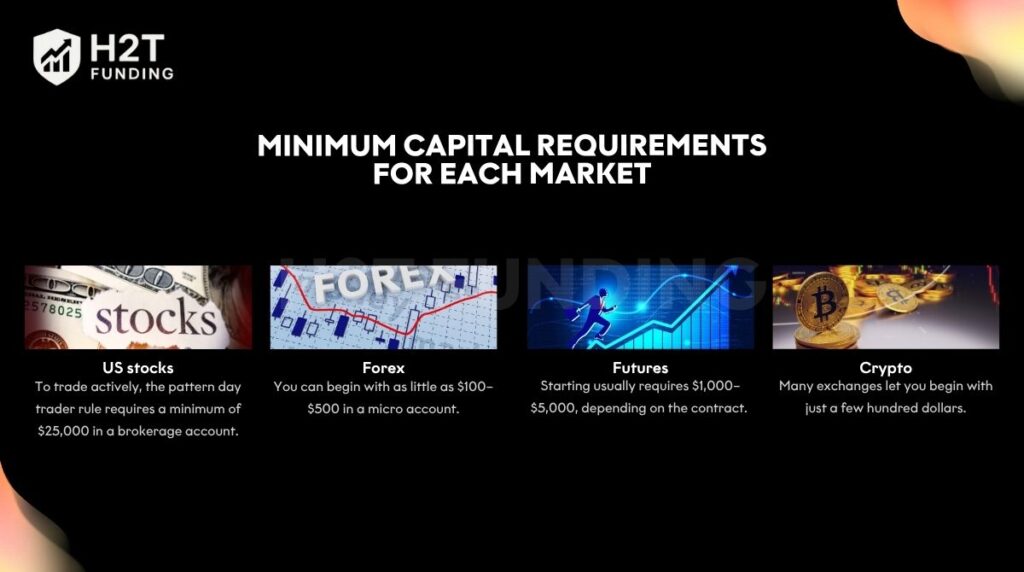 |
| Each market has its own rules, costs, and risks |
3. How risk management changes the capital requirement
Risk management directly impacts how much money you need.
Using the 1–2% rule means a $1,000 account risks only $10–$20 per trade. This limits damage during losing streaks and keeps emotions under control. Without proper risk control, no amount of capital is truly safe.
Traders who respect risk often outperform those who start bigger but trade emotionally.
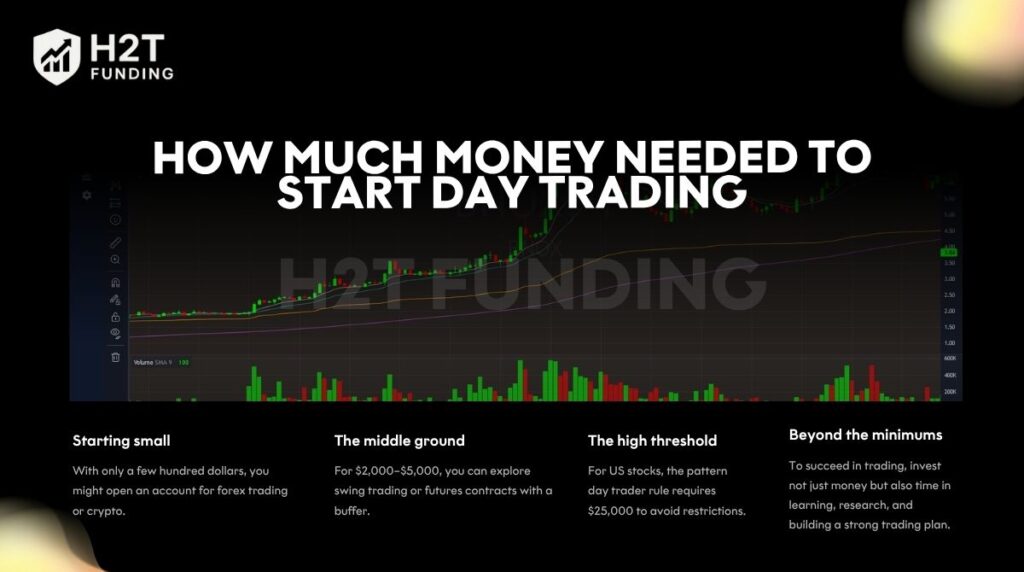 |
| The most realistic scenarios |
4. Choosing the right market with limited funds
Not all markets suit small starting capital.
Forex and crypto allow flexible entry but demand strict discipline
Futures offer leverage with defined risk, but margin rules must be respected
Stocks require $25,000 for unrestricted day trading in the U.S.
Choosing a market aligned with your budget and temperament is a key part of starting smart.
5. Alternatives if the starting capital is limited
If you do not have enough capital, there are safer alternatives than forcing trades.
Demo accounts help build structure without financial pressure
Funded trading programs allow access to larger capital after evaluation
Paper trading combined with journaling builds consistency before scaling
Skill development should come before capital expansion.
6. The long-term view on starting capital
The amount of money needed to start day trading should support learning, not urgency. Traders who survive long enough to gain experience are the ones who eventually succeed.
Starting smaller, respecting risk, and scaling gradually creates a foundation that lasts longer than any short-term win.
For a full breakdown of markets, costs, and realistic expectations, read the complete guide here:
👉 https://h2tfunding.com/how-much-money-needed-to-start-day-trading/
#funding
#h2tfunding
#nganpham
#finance
#howmuchmoneyneededtostartdaytrading
#nganphamh2t


Nhận xét
Đăng nhận xét