What Time Does the Forex Market Open? A Complete Guide to Global Trading Hours
The forex market is unique among financial markets because it operates 24 hours a day, five days a week, offering continuous trading opportunities worldwide. Officially, trading starts at 5:00 PM EST on Sunday (Sydney session) and closes at 5:00 PM EST on Friday (New York session). This rolling schedule allows traders from different regions to participate almost any time, creating a truly global trading environment.
In this guide, we’ll break down forex trading hours across major financial centres, highlight key session overlaps that drive liquidity, and explain how daylight saving time and local variations affect trading.
How the Forex Market Works
Unlike stock markets with fixed exchange hours, forex is a decentralized market. Banks, brokers, and investors trade currencies directly with each other across different time zones. Trading flows continuously through four major sessions: Sydney, Tokyo, London, and New York.
 |
| How does the Forex market work |
Understanding when each session opens and closes helps traders optimize their strategies, target high-liquidity periods, and avoid times when spreads widen due to low activity.
Forex Trading Hours Across Major Sessions
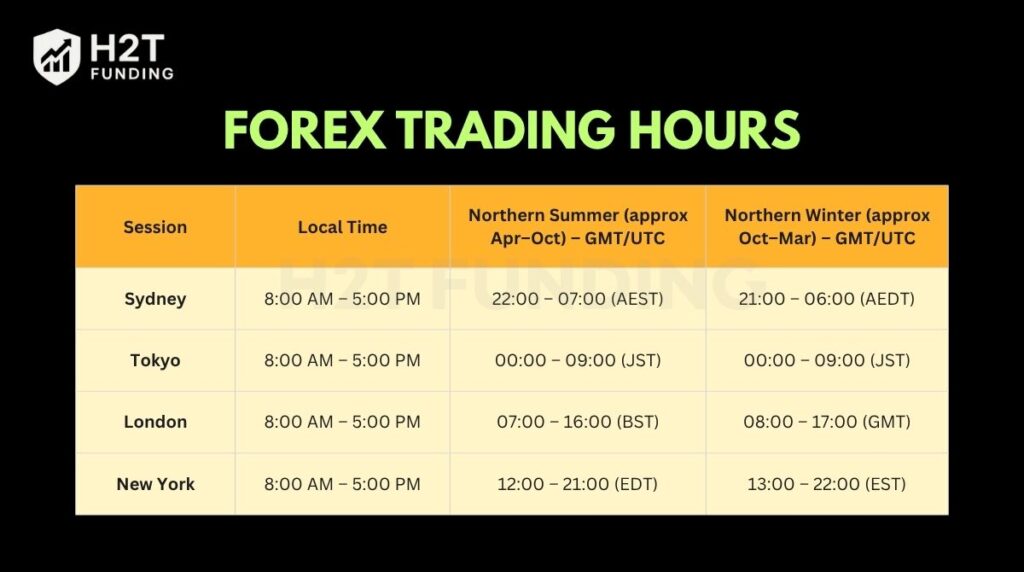
Sydney Session (Australia)
-
Local Time: 8:00 AM – 5:00 PM
-
GMT: 9:00 PM – 6:00 AM (Summer) / 10:00 PM – 7:00 AM (Winter)
-
EST: 5:00 PM – 2:00 AM (Summer) / 6:00 PM – 3:00 AM (Winter)
The Sydney session opens the week, generally with lower liquidity. Price movements are modest, and traders often use this period to spot weekend gaps or prepare for more active sessions.
Tokyo Session (Japan)
-
Local Time: 8:00 AM – 5:00 PM
-
GMT: 11:00 PM – 8:00 AM (Year-round)
-
EST: 7:00 PM – 4:00 AM
The Tokyo session handles significant activity in JPY pairs. Liquidity is higher than Sydney, and volatility is moderate, ideal for range-bound trading strategies.
London Session (UK)
-
Local Time: 8:00 AM – 5:00 PM
-
GMT: 7:00 AM – 4:00 PM (Summer) / 8:00 AM – 5:00 PM (Winter)
-
EST: 3:00 AM – 12:00 PM
London is the largest forex hub, with high liquidity and volatility. Major pairs like EUR/USD and GBP/USD experience significant movement, especially during the London–New York overlap.
New York Session (USA)
-
Local Time: 8:00 AM – 5:00 PM
-
GMT: 12:00 PM – 9:00 PM (Summer) / 1:00 PM – 10:00 PM (Winter)
-
EST: 8:00 AM – 5:00 PM
New York drives volatility with economic releases and Wall Street activity. The session is most active during its overlap with London, creating prime opportunities for day traders.
Why Session Overlaps Matter
Overlapping trading sessions bring higher liquidity and tighter spreads, often leading to stronger price movements. Key overlaps include:
-
London–New York (12:00–16:00 GMT winter / 13:00–17:00 GMT summer): Most liquid and volatile period; ideal for EUR/USD, GBP/USD.
-
Sydney–Tokyo (00:00–07:00 GMT): Steady movement for Asian pairs like AUD/JPY, NZD/USD.
-
London–Tokyo (08:00–10:00 GMT): Shorter overlap, lower activity, but can create opportunities in cross pairs like EUR/JPY.
By aligning trading strategies with these overlaps, traders can maximize efficiency and avoid low-liquidity hours.
Trading Hours in Different Regions
-
Vietnam (ICT): Sydney opens 4:00–5:00 AM Monday; New York closes 5:00–6:00 AM Saturday.
-
South Africa (SAST): Sydney opens 12:00–1:00 AM Monday; New York closes 11:00 PM – 12:00 AM.
-
Kenya (EAT): Sydney opens 12:00–1:00 AM Monday; New York closes 1:00 AM Saturday.
Knowing local equivalents of forex sessions helps traders plan entries, manage risk, and avoid trading during thin liquidity periods.
How Forex Hours Affect Trading
Not all currency pairs react the same across sessions:
-
EUR/USD, GBP/USD: Most active during London and New York sessions.
-
USD/JPY: Higher liquidity in Tokyo and New York sessions.
-
Cross pairs like EUR/JPY: Often pick up during the London–Tokyo overlap.
Aligning trades with active sessions ensures tighter spreads, smoother execution, and better market responsiveness.
Key Mistakes to Avoid
-
Assuming forex is open 24/7: Market closes Friday evening and reopens Sunday evening.
-
Trading during low-liquidity hours: Avoid early Sydney session entries with wider spreads.
-
Ignoring holidays: Liquidity drops when major financial centers are closed.
-
Overlooking DST shifts: One-hour changes in London or New York can affect session overlap timing.
Conclusion
Understanding what time does the forex market opens is crucial for developing a disciplined trading plan. Knowing session timings, overlaps, and regional conversions allows traders to focus on periods of high liquidity and avoid unproductive trading hours.
For deeper insights into trading strategies, risk management, and prop firm evaluations, check out H2T Funding’s dedicated resources for traders.
Link: 🔗 https://h2tfunding.com/what-time-does-the-forex-market-open/
#funding #h2tfunding #nganpham #finance #whattimedoestheforexmarketopens #nganphamh2t


Nhận xét
Đăng nhận xét