Topstep Funded Account Rules Explained for Traders
Understanding Topstep’s funded account rules is essential if you want to keep your account safe and avoid losing it to a simple mistake. Many traders underestimate how strict prop firm frameworks can be, especially when it comes to limits like Daily Loss Limits, Trailing Max Drawdowns, or contract restrictions. One slip—like misjudging your position size or forgetting a cut-off time—can end a $100K account instantly.
This guide breaks down the most important rules clearly and practically so you can trade confidently, avoid common pitfalls, and protect your funded account.
1. What a Topstep Funded Account Really Is
A funded account gives you the ability to trade company capital after you prove consistency in a Topstep Trading Combine. Instead of risking your own funds, you follow a defined ruleset while using firm-provided capital. Topstep offers several account sizes ($50K, $100K, $150K), each with different profit targets, position limits, and a Max Loss Limit.
 |
| What is a funded account? |
The journey starts in a simulated environment. Once you meet the requirements, you’re moved to an Express Funded Account, and from there, you can be promoted into a Live Funded Account with real payouts. Every trader must pay a one-time activation fee, and from that point forward, strict risk parameters apply.
2. Key Funded Account Rules You Must Follow
1. Daily Loss Limit
Topstep assigns a maximum amount you can lose within a single session. Going past this threshold triggers an automatic liquidation of all positions and lockout until the next session.
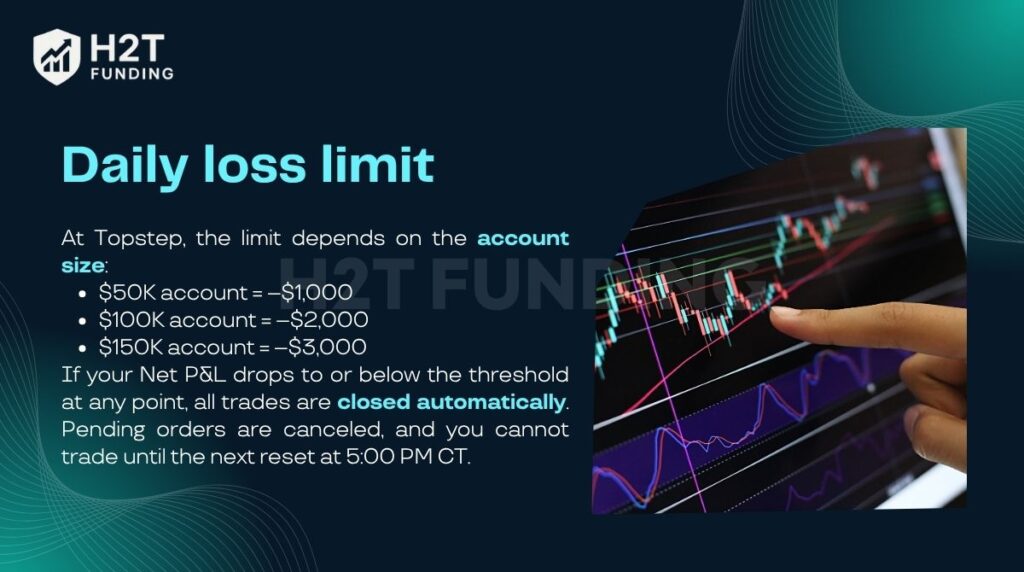 |
| The Daily Loss Limit is an objective that sets a maximum amount you can lose in a single trading session |
Typical limits:
-
$50K account: –$1,000
-
$100K account: –$2,000
-
$150K account: –$3,000
This isn’t a permanent violation, but it acts as a forced reset. You must manage intraday risk carefully because even one emotional trade can trigger a full session shutdown.
2. Trailing Max Drawdown (TMD)
The TMD is a moving minimum balance that adjusts upward as your equity grows. It protects both you and the firm by preventing you from giving back too much profit.
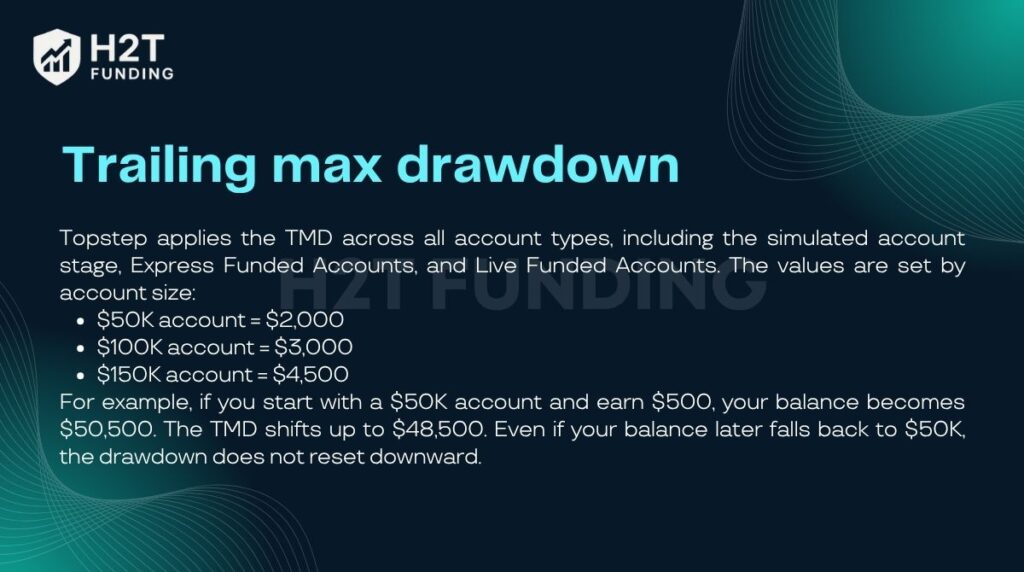 |
| The Trailing Max Drawdown follows your highest equity during the trading period and locks in gains |
TMD values:
-
$50K: $2,000
-
$100K: $3,000
-
$150K: $4,500
For example, if your $50K account reaches $50,500, the TMD locks in at $48,500. It never trails down, only up. If your balance ever touches the TMD, the account closes immediately. Once the TMD reaches the starting balance, it stops moving for the remainder of the program.
3. Scaling Plan and Position Limits
Topstep uses a Scaling Plan in Express accounts to control leverage. You can only trade more contracts when your balance grows. This prevents new traders from using oversized positions too early.
In Live accounts, Topstep now uses Dynamic Live Risk Expansion (DLRE)—a system that increases or lowers your allowed size automatically based on your performance and volatility. The better you trade, the more size you can unlock. If you draw down or markets widen, the system tightens your risk profile.
Regardless of stage, you must check your maximum lot size daily at the 5 PM CT account refresh. Oversized positions can lead to violations and forced reviews.
4. Payout Rules
Payouts depend on your stage and the number of winning days.
Express Funded Accounts:
-
Eligible after 5 winning days (each $150+ profit)
-
Up to 50% of the balance, capped at $5,000 per request
Live Funded Accounts:
-
Eligible after 5 winning days
-
Can withdraw up to 50% of profits each payout cycle
-
After 30 winning days, payouts become daily with up to 100% of your balance
Note: Choosing the full 100% payout closes the account because the remaining balance falls below the Max Loss Limit.
Payouts are processed through ACH, Wise, or wire with a $20 fee for ACH or wire withdrawals.
5. News Trading Rules
Topstep allows news trading, including around high-impact releases. But all risks from slippage or extreme volatility fall on the trader. This freedom comes with significant exposure, and many traders underestimate how unpredictable FOMC, CPI, or NFP can be. If your stop is skipped during volatility, losses count fully against your limits.
6. Weekend and End-of-Day Rules
Topstep enforces strict day-trading rules.
You must be flat by 3:10 PM CT on weekdays. The session then reopens at 5:00 PM CT. Weekend trading is not allowed, and accounts reopen at 5:00 PM CT on Sunday.
Some markets, like grains or livestock, close earlier, so traders must respect each product’s session times. Holding past any cut-off may trigger liquidation.
7. Copy Trading Rules
TopstepX allows copy trading between Combines and Express accounts. You can mirror trades from a Leader account into multiple Follower accounts, each with its own personal limits.
However:
-
Copy trading is not permitted in Live Funded Accounts
-
The Leader must always have the lowest position limit
-
If a Follower hits its personal daily loss limit or profit target, it will auto-liquidate
Proper oversight is essential because copy trading can multiply risk very quickly.
8. Automated Strategies
Automated systems are allowed, but traders are fully responsible for any malfunction. Topstep does not provide technical support, so your bot must be tested thoroughly in simulation.
If an automated strategy violates a rule, it’s treated the same as a manual violation. Your risk management system must be built into the strategy, not handled manually after the fact.
9. Trading Hours and Allowed Products
Topstep traders can access a broad range of CME futures across equities, currencies, metals, commodities, energy, and rates. Micros are allowed, though platform support varies.
They do not support:
-
Spot Forex
-
Crypto
-
Swing trading
-
Holding positions overnight
Trading is limited to intraday futures only.
3. Real Examples of How These Rules Play Out
Example 1: Daily Loss Limit Violation
A trader in a $100K account hits –$1,900, panics, adds size, and drops to –$2,050. The system instantly closes all trades. They can return next session, but the mistake resets their progress and delays payouts.
Example 2: Scaling Up at the Right Time
A $50K trader finishes the session with $1,100 profit. The next day, their Trade Report updates and unlocks 3 contracts. By patiently following the Scaling Plan instead of forcing size early, they grow consistently without violations.
Example 3: News Volatility Gone Wrong
A trader holds ES minutes before FOMC. Price spikes, the stop is skipped, and the trader loses more than planned. The loss counts fully against the daily limit and can threaten the TMD. This is why news trading requires extreme caution.
4. Common Pitfalls That Lead to Account Loss
Many traders lose funded accounts not because their strategy is bad, but because of avoidable mistakes:
-
Holding past the daily close
-
Exceeding contract limits
-
Forgetting early closes for certain products
-
Trading through extreme news without proper protection
-
Violating drawdown rules due to poor sizing
-
Administrative issues, such as inconsistent account behavior or compliance flags
Some traders have even reported unexpected closures after payouts or Combine passes, often tied to compliance reviews. Keeping full documentation and trade logs helps protect you during audits.
5. Conclusion
Topstep’s funded account rules are designed to enforce discipline, protect firm capital, and strengthen trader consistency. While strict, these rules also create a framework for long-term success if you follow them closely. Understanding your Daily Loss Limit, Trailing Drawdown, and contract limits is only the beginning—you must also manage news events, trading hours, automation, and payouts with precision.
When applied correctly, these rules help you stay in the game longer, build sustainable habits, and turn funded trading into a genuine opportunity for growth.
Read the full guide here: https://h2tfunding.com/topstep-funded-account-rules/
#funding #h2tfunding #nganpham #finance #topstepfundedaccountrules #nganphamh2t


Nhận xét
Đăng nhận xét