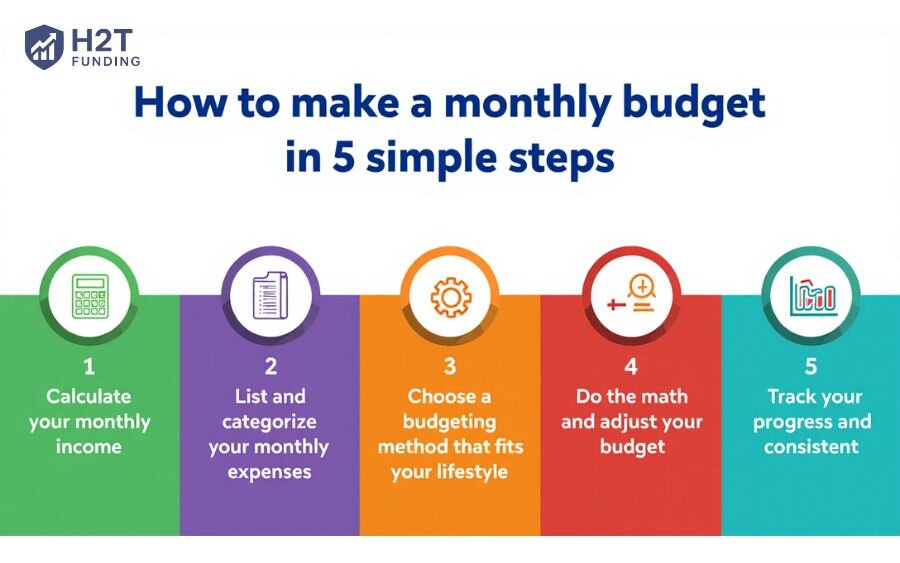
How to make a monthly budget in 5 simple steps
The easiest way to build a strong, realistic budget is to break it down into clear, manageable steps. These five steps will help you organize your income, track your spending, and align your money with your goals, no guesswork, no overwhelm.
3.1. Step 1: Calculate your monthly income
Before you can plan where your money should go, you need to know exactly how much is coming in. Start by calculating your total take-home pay, the amount that actually lands in your bank account after taxes and deductions.
If you earn a fixed salary, this part is straightforward. Check your most recent pay stub or bank statement to confirm your net income. Include all consistent sources: full-time wages, part-time jobs, freelance contracts, or government benefits.
For those with irregular or variable income, such as freelancers, commission-based earners, or gig workers, take the average of your income over the past 3 to 6 months. Use conservative estimates. For example, if your income fluctuates between $2,000 and $3,500 monthly, consider budgeting around $2,000 to stay on the safe side.
Also include any additional income that you receive regularly, such as rental income, alimony, or side hustle earnings. Avoid counting one-time payments like bonuses or gifts unless they are guaranteed monthly.
Maybe you need to know: Budgeting for irregular income: 6 essential steps you need to know
3.2. Step 2: List and categorize your monthly expenses
Now that you know your income, the next step is to track where your money goes. Start by reviewing your bank and credit card statements from the past 1–3 months. Write down every recurring or common expense.
To make budgeting easier, group your expenses into three categories:
- Fixed expenses: These are predictable and usually the same every month. Examples include rent or mortgage, insurance, student loans, and subscription services like Netflix or Spotify.
- Variable expenses: These change month to month. Examples include groceries, fuel, dining out, entertainment, and clothing. These are also the easiest to adjust if your budget is tight.
- Sinking funds: These cover large or irregular costs you plan for in advance, like vacations, holiday gifts, car maintenance, or a new phone. Instead of paying all at once, set aside a small amount monthly.
Tracking your spending by category helps you see patterns, find waste, and plan better for both essentials and goals.
Sample monthly expense tracker
| Expense Category | Planned Amount | Actual Amount |
| Rent / Mortgage | $1,000 | $1,000 |
| Groceries | $300 | $310 |
| Transportation | $150 | $140 |
| Utilities | $100 | $95 |
| Insurance | $120 | $120 |
| Entertainment | $100 | $130 |
| Savings | $200 | $200 |
| Sinking Fund: Vacation | $100 | $100 |
If you're more of a spreadsheet person, consider learning how to make a monthly budget in Excel or how to make a monthly budget in Google Sheets. Both platforms offer flexible templates and built-in formulas that automatically calculate totals, making budgeting easier and more visual. You can:
- Use templates with categorized expenses.
- Set up conditional formatting to spot overspending.
- Easily adjust projections month-to-month.
These tools are perfect for people who prefer a DIY, customizable approach, plus, they’re free!
3.3. Step 3: Choose a budgeting method that fits your lifestyle
There’s no perfect budget for everyone. Choose a method that matches how you think and spend:
- 50/30/20 rule: Spend 50% on needs, 30% on wants, and 20% on savings or debt. Great for beginners who want structure without too much detail.
- Envelope system: Use cash, divide it into labeled envelopes by category (like groceries, gas). When one’s empty, stop spending. Ideal for hands-on control.
- Zero-based budgeting: Assign every dollar a job so income minus expenses equals zero. Most detailed, great for those who want full control.
Start with the one that feels manageable, and adjust as your habits evolve.
Discover more to view all guide: https://h2tfunding.com/how-to-make-a-monthly-budget/
#funding
#h2tfunding
#nganpham
#finance
#howtomakeamonthlybudget
#nganphamh2t


Nhận xét
Đăng nhận xét